Artist Statement
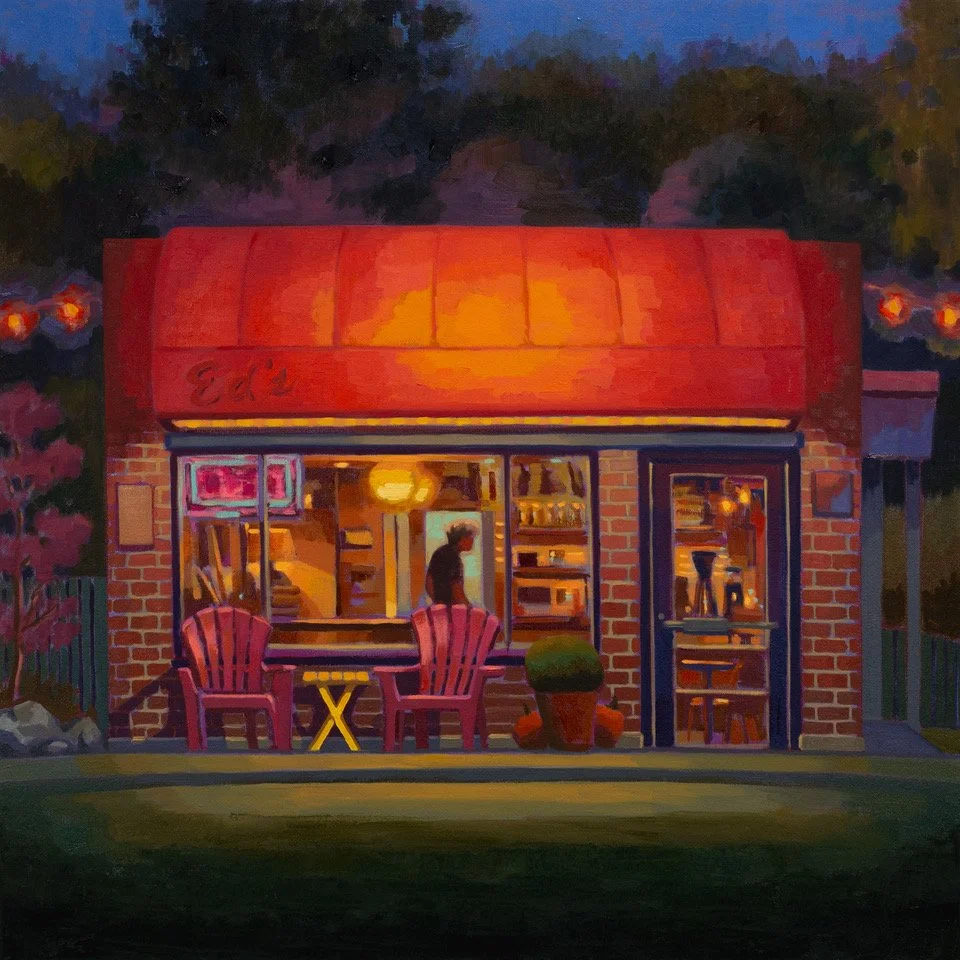
Into the Inhabited Silence explores the psychological space where human habitations meet the infinite expanse of the wild. Rather than painting traditional landscapes, this body of work examines the small structures we build to anchor ourselves within nature. A rural gas station, a lone pickup truck, or a glowing storefront at dusk become vital sanctuaries of human warmth.
Having spent much of my life in dense, humming urban environments, encountering the quiet vastness of the Canadian West Coast brought a profound shift in perspective. It introduced an unfamiliar, heavy solitude that forced a deeper way of looking. In these paintings, that isolation is translated through a high-key, cinematic palette. The vibrant, internal light of these structures acts as a visual heartbeat, pushing back against the dark weight of the surrounding forest.
Ultimately, these works function as portraits of co-existence. They capture the quiet friction of daily life in places where wildlife and human infrastructure share the same space. By framing everyday utility against an overwhelming natural backdrop, the series measures our fundamental smallness in the world, while honouring the quiet ways we carve out.
Bio
Liang Wang (b. 1992) is a Taiwanese-Canadian painter based in Vancouver, BC. His practice investigates the psychological landscape of modern isolation, cultural memory, and the quiet frictions of daily co-existence. Having navigated a deeply nomadic youth across multiple continents and cultures, Wang’s work is underpinned by an enduring inquiry into what it means to belong, translating the vulnerabilities of displacement into evocative visual narratives. Wang holds a Bachelor of Fine Arts from OCAD University in Toronto. He has exhibited widely across Canada and Taiwan, with selected exhibitions including Art With Heart Auction at Casey House, Toronto (2026 & 2024); Fragments of Passage at the Centre of International Contemporary Art, Vancouver (2024); Akin x MOCA: An Index at MOCA Toronto (2019). Wang’s work is held in private collections in Canada, the United States, Taiwan, Denmark and New Zealand.